

3D Adventurer [Equatorial Mount for DSLR] : 8 Steps (with Pictures) - wisemanoverniusher
Introduction: 3D Venturer [Equatorial Mount for DSLR]
As a big winnow of astrophotography and 3D printing I had to build my own circle bestrid for my DSLR.
For this cast I used Fusion 360 to design all the pieces.
With this instructable you tush design your own or you give the sack use my STL files and espouse the assembly tutorial.
Enjoy!
Supplies
Electric:
- 1x stepper motor 28BYJ-48 5V
- 1x ULN2003 driver board
- 1x Arduino (I utilized nano but every arduino will work)
- 2x push push (I used a double momentary toggle switch)
- 2x LED 3mm (1x Orange + 1x Red)
- 1x District of Columbia jack adapter
- wires, bonding iron,
Mechanic:
- 2x ball bearing (10-30-9)
- 1x metal metro 105~110 mm long with extraneous diameter reported to the bearing (here 10 mm)
- 3D printer + PLA
- Screws + nuts (I used M2.5 kit)
- 1x M8 threaded gat + M8 nuts
- Heavy stuff
Others:
- 1x DSLR camera + lens
- 1x Tripod (mine is a Manfrotto Compact Advanced)
- 1x Camera globe multilateral
- 1x Kodak screw to mount the testis joint
- CAD package if you wishing to modify the files (unification 360 is free for students)
Step 1: Function
As you know, Solid ground is rotating, so IT is not hands-down to shoot stars because they leave star-trails.
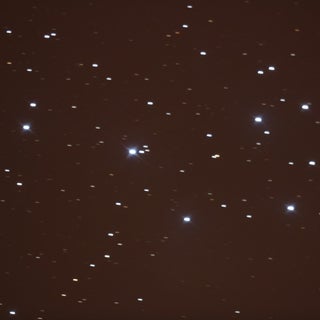
In astrophotography, we use the "500 Rule" it allows to bring forward pictures of the nighttime sky without noticeable stellar trails: divide 500 by the point length of your genus Lens and you will obtain the level bes exposure sentence. However, with the graze factor of my DSLR it turns extinct to be the "300 Rule". My lens is a Canon 24mm f2.8 so according to the prevai: 300/24=12.5 I can only shoot stars during 12.5s and that is very short to capture enough light from them.
The twist I made is tracking stars, that allows to get rid of that prevai and frivol away as yearn as we need.
Fortunately the rotation of the Globe is well known, the axis is perfunctory finished the north celestial pole and the gyration speed is 1rev/23h56min4s (stellar day)
With that we can create a device that turns on a duplicate axis and at the exact opposite speed as the Earth.
It is called "equatorial mount", it is commonly in use with a telescope because with only 1 causative information technology tracks stars.
More or less of them are big and rattling powerful in order to rotate enormous telescopes but some others are minuscule carrying just a DSLR that is what I wanted to make.
IT can also be useful to realise timelapse according to earth's rotation.
Step 2: Designing
First, 1rev/23h56min4s is lazy, very sluggish. And for my star tracker I wanted as few gear wheels as possible in order to reduce play in the chemical mechanism that is why I didn't make a planetary gear. I decided to make a simple gear reducer with only 2 wheels, one with 10 teeth and the other with 60 teeth, that way, it divide the speed by 6 and multiply the torque by 6, idealized !
The main shaft is made from a copper tube the material is not very important but IT must be a tube, you will interpret why later. It has a diameter of 10mm because I had some 10-30-9 bearings (those may be oversized just IT results in a very reliable revolute joint)
I used a 5VDC 28BYJ-48 high stepper motor, which is not very powerful but with the geared wheel ratio information technology should be enough
As I sleep in the north hemisphere at roughly 45° latitude I tilted the Manfrotto socket past 45° the adjustments will be ensured away the tripod head.
I designed each the parts using Fusion 360.
on the 2nd picture, pieces with a "*" are not 3D printed.
Step 3: 3D Impression
I 3D printed entirely the parts along my Creality Ender 3 with those settings:
- Cura slicer
- ICE filament 1.75mm
- nozzle 210°C
- bed 50°C
- 20% infill (gyroïd)
- 0.16mm / 0.2mm layer height
- no supports
- Ø 0.4mm nozzle
- 40mm/s
the gross printing duration is roughly 12h.
Here is the Cults3D link to the files: Here (.stl and .f3d)
Step 4: Prototyping
23h56min4s is equal to 23.9344444...h
1rev/23.934444h on the main shaft --> 1rev/3.989074h on the efferent jockey
4076steps/rev on the motor --> 1 step every 3.523s [3.523225s]
The DSLR corset motionless during exactly 3.523s so reported to the 500 and 300 Rule : the equatorial saddle horse will work with lens below 142mm focal length along a full moon frame and below 85mm on a crop sensor.
In prescribe to drive the motor with 4076 steps, there is this Arduino library by tyhenry.
Here is the code to put away in the arduino board if you sleep in the northern hemisphere .
/*<br>Survey by SimonRob 3D printed equatorial setting for DSLR Instructables */ int buttonA1 = 0; int buttonA2 = 0; int ledOrange = 4; int ledRed = 5; #include <CheapStepper.h> CheapStepper stepper; quash setup() { pinMode(A1, INPUT); pinMode(A2, INPUT); pinMode(ledOrange, OUTPUT); pinMode(ledRed, Output signal); } nullif loop() { buttonA1 = digitalRead(A1); buttonA2 = digitalRead(A2); if (buttonA1 == HIGH){ buttonA1 = digitalRead(A1); buttonA2 = digitalRead(A2); digitalWrite (ledOrange, HIGH); digitalWrite (ledRed, Lowly); stepper.step(false); hold(6); } if (buttonA2 == Heights){ buttonA1 = digitalRead(A1); buttonA2 = digitalRead(A2); digitalWrite (ledOrange, HIGH); digitalWrite (ledRed, LOW); stepper.step(true); delay(6); } while((buttonA1 == Low-down)&&(buttonA2 == LOW)){ buttonA1 = digitalRead(A1); buttonA2 = digitalRead(A2); digitalWrite (ledOrange, LOW); digitalWrite (ledRed, HIGH); stepper.step(treacherously); time lag(3523); } } the appendage videoenquirer modified the previous cipher for the southern hemisphere :
Step 5: Assembly
Step 6: The Controller
Once printed, screw in direct the ii PCB (Arduino + ULN2003 number one wood) and place the components in the box.

Solder wires according to this schematic:
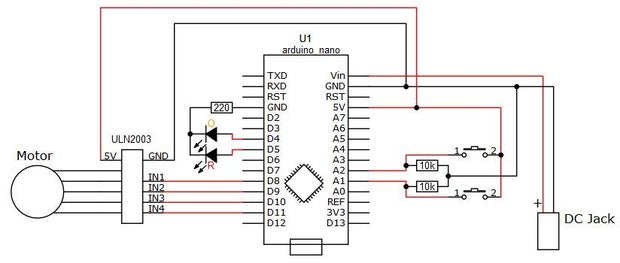
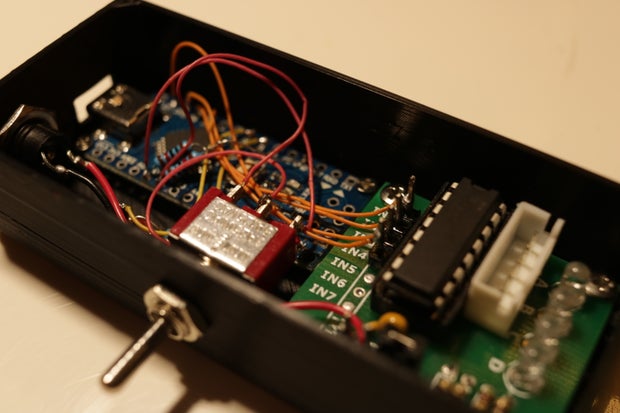
Then plug the motor and snip off the palpebra on the box
Step 7: How to Use It?
- Place the star tracker on the tripod (tube pointing to the north).
- Screw the DSLR on the ball common, and add the counterweights connected the separate side.
- Remove the limited paraphernalia wheel from the motor to button the axis.
- Then set the counterweight to balance the rotating part, and put back the small gear bicycle.
- Investigate the tube and aline the head of the tripod the see the Northerly Star into it (you can also use a laser through and through the tube).
- Index on the pantropic mount and enjoy !
Tread 8: Astrophotography
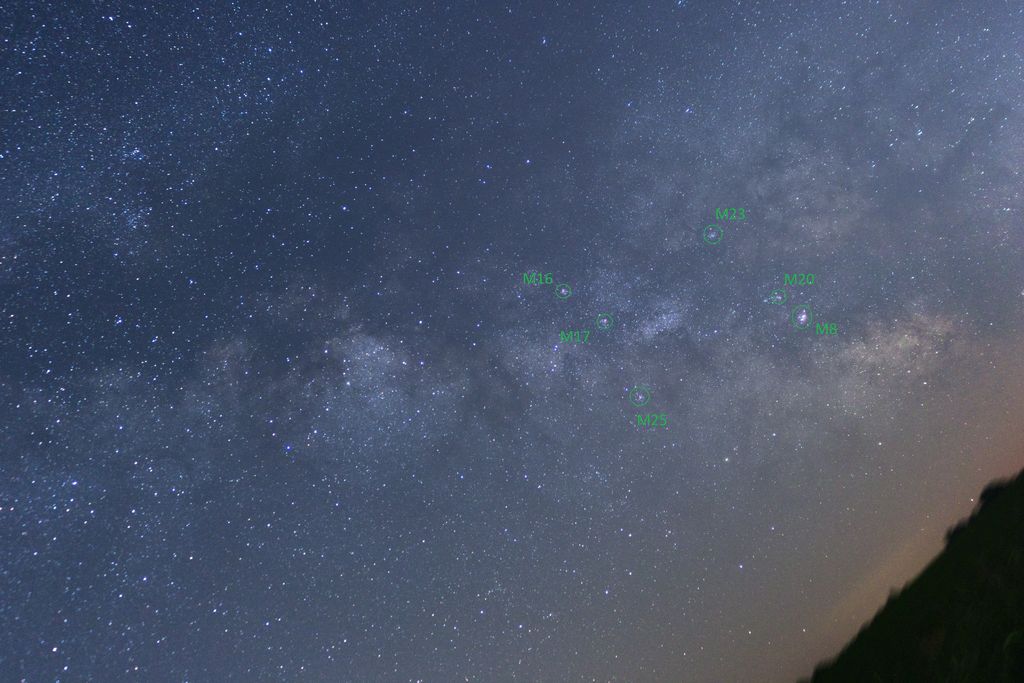
Here is my first photography with the mount :


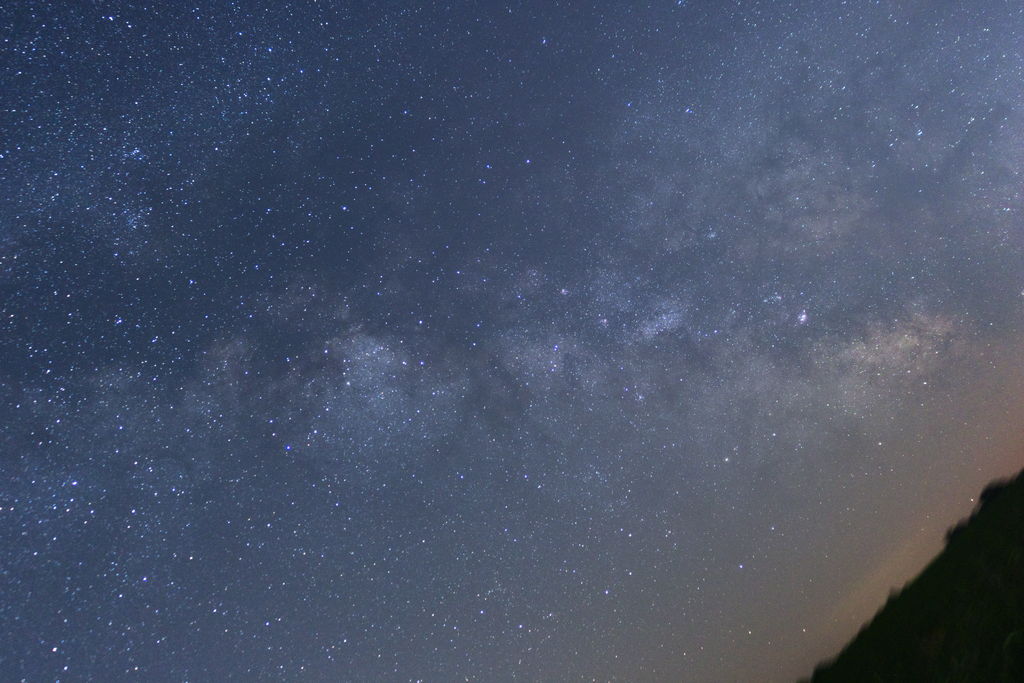
Here is a show of thorium milky way,
Canon 750D, Equatorial mount, Canon 18-55mm stm (at 27mm), f/4, iso1600, 196s
You can buoy see that even at 196s exposure, stars stays dots (except in the corners due to chromatic aberations) however there is a motion blur on the trees. If you want them sharp excessively, you bequeath have to minimal brain dysfunction a motionless scene of your foreground and mix those into Photoshop or Gimp.
on the picture we can easely notice some wide toss objects:
I too practice astrophotography with a scope, you seat see my photos on Instagram ;)
7 People Made This Project!
Recommendations
Source: https://www.instructables.com/Equatorial-Mount-for-DSLR/
Posted by: wisemanoverniusher.blogspot.com
0 Response to "3D Adventurer [Equatorial Mount for DSLR] : 8 Steps (with Pictures) - wisemanoverniusher"
Post a Comment